
Arkansas Ten Commandments Law Should Be Restored
Jun 5, 2026
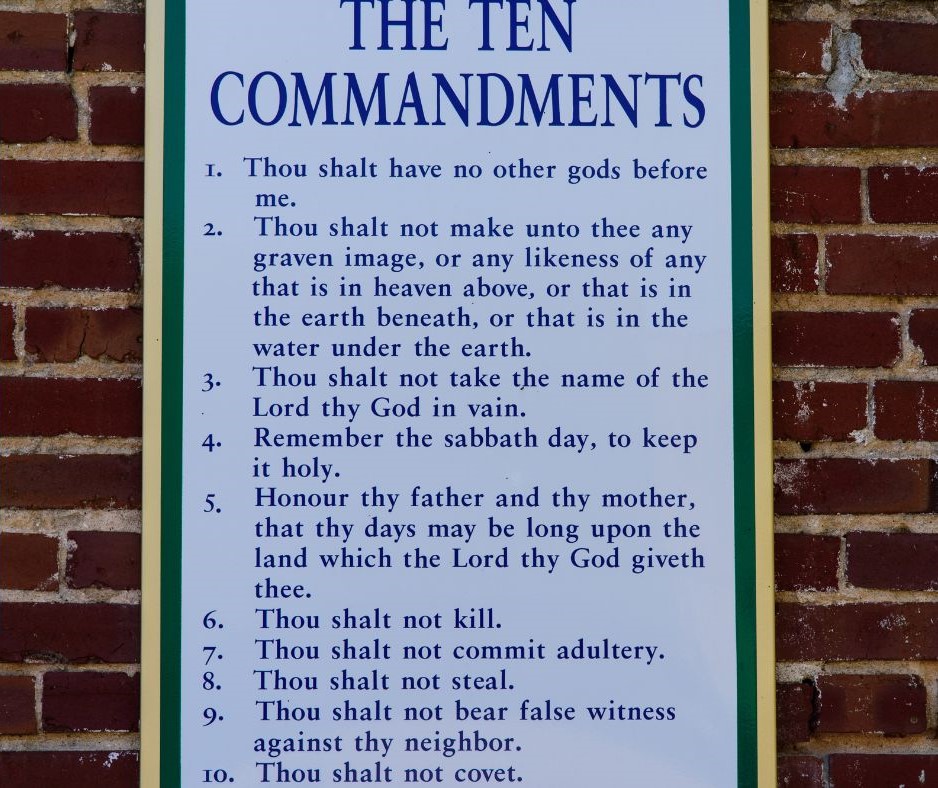
Liberty Counsel filed an amicus brief in Stinson v. Arkansas urging the Eighth Circuit Court of Appeals to reverse a lower court decision and uphold Arkansas’ law requiring the Ten Commandments be posted in public school classrooms.
In March 2026, the U.S. District Court for the Western District of Arkansas permanently blocked all six school districts statewide from complying with the portion of Senate Bill 433 (Act 573) that pertains to displaying posters of the Ten Commandments in every school “library and classroom.” The law is challenged by plaintiff Samantha Stinson who believes the displays are a form of religious instruction which “conflicts” with her “family’s Jewish tenets and practice.”
In the lower court ruling, Judge Timothy Brooks wrote that the law “serves no educational purpose.” He determined that “the only reason to display a sacred, religious text in every classroom is to proselytize to children,” which violates Free Exercise rights and the Establishment Clause.
However, Liberty Counsel argues that recent U.S. Supreme Court decisions have fundamentally reshaped how courts should analyze the intersection of religion and public settings, and have strengthened protections for religious expression in public. In the brief, Liberty Counsel notes that older court decisions striking down public displays of the Ten Commandments relied on the now-defunct “Lemon Test,” which took a narrow approach equating things with a religious nature in the public square as religious establishment.
In Liberty Counsel’s 9-0 victory in Shurtleff v. City of Boston regarding raising the Christian Flag in a government-sanctioned public forum, the Court emphasized that the government cannot exclude religious viewpoints in a public forum based on their religious nature without engaging in unconstitutional viewpoint discrimination. The Shurtleff decision was a turning point that ignored the “Lemon Test” and confirmed that religious expression is not automatically excluded from the public square.
Shortly after Shurtleff, SCOTUS rejected the “Lemon Test” altogether in Kennedy v. Bremerton School District ruling that courts must instead look to the nation’s “history and traditions” to determine whether a law amounts to an unconstitutional establishment of religion as understood by the Founders.
As applied to Arkansas’ Ten Commandments law, these precedents suggest that passive public displays with a religious connection do not constitute a “founding-era” understanding of religious establishment, such as requiring someone to perform a religious practice, wrote Liberty Counsel.
The brief notes that while Judge Brooks acknowledged the “Lemon Test” had been overruled, he struck down Arkansas’ law using rationale from other court decisions that relied on the test rather than taking the “history and traditions” approach.
The “historical hallmarks” of religious establishment the Founders prohibited included “legal compulsion to ‘attend church’ or ‘engage in formal religious exercise,’” the brief reads.
“Arkansas’ requirement to post the Ten Commandments in schools, with zero requirement for any lessons pertaining to it, any official student recognition of its teachings, or punishment for any dissenter, is a far-cry from establishing any religion,” wrote Liberty Counsel. “The Founders fought for freedom not from a passive placement of a religious text on the walls of public classrooms, but from a legal authority to punish dissenters of a particular religion. And, to hold that these very drafters of the Establishment Clause would have understood it to prohibit the inclusion of the Ten Commandments, is an ahistorical and incorrect conclusion.”
The brief also emphasizes that “much of American law is based on the Ten Commandments.” As a universal symbol of law and morality, Ten Commandments displays appear in courthouses, legislative buildings and many other public places around the country reflecting their historical significance rather than imposing religious belief.
Historically, religious establishment involved “coercive actions,” but SCOTUS has determined that mere exposure is not coercion. Arkansas’ law does not require teachers or students to read, recite, or follow the Ten Commandments. Rather, the law “merely requires” they be posted in classrooms “for ceremonial, celebratory, or commemorative purposes,” and as such the displays come “with a presumption of constitutionality,” concluded Liberty Counsel.
Arkansas’ law requires that public schools, higher education institutions, libraries, and government buildings prominently display a “durable” Ten Commandments display at least 16 inches by 20 inches with “text legible to a person with average vision from anywhere in the room.” Displays must also be funded through voluntary contributions.
Liberty Counsel’s Founder and Chairman Mat Staver said, “Arkansas’ law fits comfortably within the Constitution because passive Ten Commandments displays neither establishes a state religion nor coerces religious activity. The Ten Commandments have indelibly shaped American law and government, and passive displays in the public classrooms merely recognize its role in our nation’s heritage. There are about 50 displays of the Ten Commandments inside and outside the United States Supreme Court and a prominent display at the Library of Congress and on the floor of the National Archives. Arkansas’ law needs to be evaluated under the U.S Supreme Court’s ‘history and traditions’ framework where religious content does not equal coercion, and the lower court decision should be reversed and the law restored.”
Liberty Counsel advances religious liberty, the sanctity of human life, and the family through litigation and education. We depend on your support, which enables us to represent people at no cost. Click here to GIVE NOW.

TAKE ACTION


Post Office Box 540774
Orlando, FL 32854
(407) 875-1776
Contact: LEGAL HELP
Contact: Other Issue/Question
Name
Choose Password
SIGN UP TO STAY INFORMED!
Liberty Counsel is a 501(c)(3), tax-exempt nonprofit organization. Contributions are tax-deductible to the extent permitted by law.
View our Privacy Policy.
©Copyright 1995 - present. All Rights Reserved.


