
SCOTUS Weighs Religious Discrimination in Colorado’s Preschool Program
Nov 3, 2026
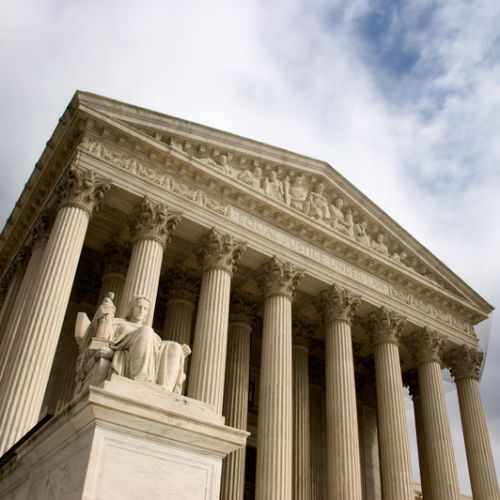
Today, the U.S. Supreme Court heard oral arguments in St. Mary Catholic Parish v. Roy, a case where Colorado’s “universal” preschool program is excluding Catholic parents and preschools from receiving state funds due to their religious convictions. The preschool program includes a provision that requires the schools to accept children from same-sex households or LGBTQ families in order to receive public funding.
Two Catholic parishes, the Archdiocese of Denver, and a set of parents challenge the preschool program contending the state is unconstitutionally excluding them from a “universal” public benefit because the schools limit enrollment to only those who abide by the Catholic faith and its teachings. The plaintiff’s note that while Colorado allows secular schools to impose their own enrollment requirements and priorities, such as low-income status, disabilities, or LGBTQ status, Catholic schools are denied a religious accommodation and deemed ineligible due to their religious faith.
The plaintiffs presented two questions to the High Court:
- Whether proving a lack of general applicability under Employment Division v. Smith requires showing unfettered discretion or categorical exemptions for identical secular conduct.
- Whether Carson v. Makin displaces the rule of Employment Division v. Smith only when the government explicitly excludes religious people and institutions.
In the 1990 Smith decision, SCOTUS ruled that state governments can burden religion if its actions are neutral and generally applicable. In the 2022 Carson decision, SCOTUS ruled that a state may not withhold public funds from a religious school simply because the school is religious.
In a two-hour oral argument, the Justices debated whether Colorado can require religious schools to undertake a burden to their religious exercise, such as accepting students from LGBTQ families, as a condition for public funding.
Justices Elena Kagan, Sonia Sotomayor, and Ketanji Brown Jackson questioned whether the Catholic schools and parents wanted to extend the Carson ruling to create a special accommodation for religious entities to be treated differently because of their religion. The three Justices also contended that Colorado’s law is grounded in a neutral anti-discrimination principle and allowing a special exemption would allow discrimination against a specific, protected class of people.
Nicholas R. Reaves, the attorney for the Catholic schools, responded that Carson should be applied here to look at this case from the perspective of the religious believer who is being excluded from a public benefit. Reaves noted that the 2,000 other schools in the program can favor certain characteristics (e.g., low income, LGBTQ) and the religious schools are simply asking for the same treatment. He noted that Colorado is denying equal access to this public benefit based on the religious schools' own protected characteristic—their religious exercise to accept those who agree with their teachings and doctrines.
Deputy Solicitor General Helen Norton for Colorado stated that St. Mary Catholic Parish took part in a working group regarding the formation of the program illustrating that the state worked to include religious schools and that the program does not interfere with what religious schools teach.
Several of the conservative Justices focused questions on the effect of the law rather than just its neutral language. Justice Samuel Alito stated that the U.S. Constitution does not allow governments to do indirectly what it can’t do directly. He noted that the High Court has previously sided against Colorado in a string of cases involving the state infringing on the First Amendment rights of Christians. He cited Chiles v. Salazar, 303 Creative v. Elenis, and Masterpiece Cakeshop v. Colorado Civil Rights Commission, where Colorado attempted to enforce other nondiscrimination provisions, yet those attempts were found to be discriminatory against a Christian counselor, web designer, and baker, respectively.
Both Justice Alito and Justice Amy Coney Barrett questioned Colorado’s program and its exclusionary effect considering the state knew in advance that some religious schools would not be able to accept the nondiscrimination requirement.
Norton stated there is “no evidence of animus or hostility” in this case and that Colorado wants to invest its public funds to ensure equal opportunity to all protected classes.
Reaves concluded that the court has previously determined in its case law that there is an “obligation of neutrality in the face of religious differences.”
“If someone is differently situated because of their religion, then accommodation is neutrality,” Reaves stated.
A decision in the case is expected by the end of June 2027.
Liberty Counsel filed an amicus brief to the U.S. Supreme Court in the case arguing that neutral laws can still burden religion even without explicit hostility. Liberty Counsel argues when a state has knowingly closed a public benefit program to an identifiable religious community, then it has imposed a “religious gerrymander” on religious objectors. Since state officials knew of the rule’s effect and proceeded without change, there is sufficient cause to challenge the rule and show discriminatory intent, which is prohibited under the Free Exercise of Religion and the Equal Protection Clause, reads the brief.
Liberty Counsel Founder and Chairman Mat Staver said, “When a state promises a ‘universal’ program but rejects a religious organization because it won’t compromise its religious doctrine, then it has become discriminatory. States cannot exclude religious families or organizations from a public benefit because of their religious practice. The Tenth Circuit decision against St. Mary Catholic Parish should be reversed.”
Liberty Counsel advances religious liberty, the sanctity of human life, and the family through litigation and education. We depend on your support, which enables us to represent people at no cost. Click here to GIVE NOW.

TAKE ACTION


Post Office Box 540774
Orlando, FL 32854
(407) 875-1776
Contact: LEGAL HELP
Contact: Other Issue/Question
Name
Choose Password
SIGN UP TO STAY INFORMED!
Liberty Counsel is a 501(c)(3), tax-exempt nonprofit organization. Contributions are tax-deductible to the extent permitted by law.
View our Privacy Policy.
©Copyright 1995 - present. All Rights Reserved.


